

- tapir
-
any of several large, stout, three-toed ungulates of the family Tapiridae, of Central and South America, the Malay Peninsula, and Sumatra, somewhat resembling swine and having a long, flexible snout: all species are threatened or endangered.[1560-70; Tupi tapira]
* * *
Any of four extant members (genus Tapirus) of the family Tapiridae, heavy-bodied, odd-toed ungulates, 6–8 ft (1.8–2.5 m) long and up to 3 ft (1 m) high.They have short ears and legs and a fleshy snout overhanging the upper lip. The feet have three functional toes. Body hair is usually short and sparse, but two species have a short, bristly mane. The Malayan tapir (T. indicus) has a black head, shoulders, and legs and white rump, back, and belly. The single Central and two South American species are plain brown or gray. Tapirs inhabit the deep forest or swamp.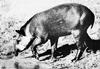 Lowland tapir (Tapirus terrestris)Warren GarstTom Stack & Associates
* * *
▪ mammal(genus Tapirus)any of four species of hoofed mammals, the only extant members of the family Tapiridae (order Perissodactyla), found in tropical forests of Malaysia and the New World. Heavy-bodied and rather short-legged, tapirs are 1.8 to 2.5 m (about 6 to 8 feet) long and reach about 1 m at the shoulder. The eyes are small, the ears are short and rounded, and the snout extends into a short fleshy proboscis, or trunk, that hangs down over the upper lip. The feet have three functional toes, the first (inner) being absent, and the fifth reduced in front and absent in the hind foot. Body hair is short and usually sparse but fairly dense in the mountain tapir (T. pinchaque, formerly T. roulini). There is a short, bristly mane in the Central American, or Baird's, tapir (T. bairdii) and the South American lowland tapir (T. terrestris; see photograph—>). This geographic distribution, with three species in Central and South America and one in Southeast Asia, is peculiar. Fossil remains from Europe, China, and North America show that tapirs were once widespread, but the extinction of intermediate forms has isolated the living species.The three New World species are plain dark brown or gray, but the Malayan tapir (T. indicus) is strongly patterned, with black head, shoulders, and legs and white rump, back, and belly. The young of all tapirs are dark brown, streaked and spotted with yellowish white. A single young (rarely two) is produced after a gestation of about 400 days.Tapirs are shy inhabitants of deep forest or swamps, traveling on well-worn trails, usually near water. When disturbed, they usually flee, crashing through undergrowth and often seeking refuge in water. Their main enemy wherever they are found is man; in South America the jaguar is a principal predator, and in Asia the tiger is another predator. Despite declining numbers caused largely by habitat destruction, tapirs are hunted for food and sport in many parts of their range.* * *
Universalium. 2010.