

- Petra
-
/pee"treuh, pe"-/, n.an ancient city in SW Jordan: ruined structures carved out of varicolored stratified rock; capital of the Nabataeans and Edomites.
* * *
Ancient city, Middle East.Located in what is now southwestern Jordan, it was the capital of the Nabataean kingdom from с 312 BC until its defeat by the Romans in AD 106. It then became part of the Roman province of Arabia. After several centuries as a flourishing trade centre, it declined with the shifting of trade routes to the Euphrates River and the Persian Gulf. It was captured by the Muslims in the 7th century. Its ruins were visited in 1812 by the Swiss traveler, Johann L. Burckhardt, who was the first European to see the site. Subsequent excavations have revealed many rock-cut monuments, including tombs with elaborate facades carved in the rose, crimson, and purple sandstone of the surrounding hills.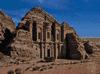 The Nabataean rock-cut monument of Ad-Dayr, Petra, Jordan.Brian Brake from Rapho/Photo ResearchersEB Inc.
* * *
▪ ancient city, JordanArabic Baṭrāancient city, centre of an Arab kingdom in Hellenistic (Hellenistic Age) and Roman (ancient Rome) times; its ruins are in southwest Jordan. The city was built on a terrace, pierced from east to west by the Wadi Mūsā (the Valley of Moses)—one of the places where, according to tradition, the Israelite leader Moses struck a rock and water gushed forth. The valley is enclosed by sandstone cliffs veined with shades of red and purple varying to pale yellow, and for this reason Petra was called by the 19th-century English biblical scholar John William Burgon a “rose-red city half as old as Time.”The Greek name Petra (“Rock”) probably replaced the biblical name Sela. Remains from the Paleolithic (Paleolithic Period) and the Neolithic (Neolithic Period) periods have been discovered at Petra, and Edomites (Edom) are known to have occupied the area about 1200 BC. Centuries later the Nabataeans (Nabataean), an Arab tribe, occupied it and made it the capital of their kingdom. In 312 BC the region was attacked by Seleucid forces, who failed to seize the city. Under Nabataean rule, Petra prospered as a centre of the spice trade that involved such disparate realms as China, Egypt, Greece, and India, and the city's population swelled to between 10,000 and 30,000.When the Nabataeans were defeated by the Romans in AD 106, Petra became part of the Roman province of Arabia but continued to flourish until changing trade routes caused its gradual commercial decline. After an earthquake (not the first) damaged the city in 551, significant habitation seems to have ceased. The Islamic (Islām) invasion occurred in the 7th century, and a Crusader outpost is evidence of activity there in the 12th century. After the Crusades, the city was unknown to the Western world until it was rediscovered by the Swiss traveler Johann Ludwig Burckhardt (Burckhardt, Johann Ludwig) in 1812.Excavations from 1958 on behalf of the British School of Archaeology in Jerusalem and, later, the American Center of Oriental Research added greatly to knowledge of Petra. The ruins are usually approached from the east by a narrow gorge known as the Sik (Siq, or Wadi as-Sīk). Among the first sites viewed from the Sik is the Khasneh (“Treasury”), which is actually a large tomb. Ad-Dayr (“the Monastery”) is one of Petra's best-known rock-cut monuments; it is an unfinished tomb facade that during Byzantine times was used as a church. Many of the tombs of Petra have elaborate facades and are now used as dwellings. The High Place of Sacrifice, a cultic altar dating from biblical times, is a well-preserved site. To support the ancient city's large population, its inhabitants maintained an extensive hydrological system, including dams, cisterns, rock-carved water channels, and ceramic pipes. Excavations begun in 1993 revealed several more temples and monuments that provide insight into the political, social, and religious traditions of the ancient city. The ruins are vulnerable to floods and other natural phenomena, and increased tourist traffic has also damaged the monuments. In 1985 Petra was designated a UNESCO World Heritage site. See also art and architecture, Iranian: Petra and Palmyra (art and architecture, Iranian).* * *
Universalium. 2010.