

- pea
-
pea1
—pealike, adj.n.1. the round, edible seed of a widely cultivated plant, Pisum sativum, of the legume family.2. the plant itself.3. the green, somewhat inflated pod of this plant.4. any of various related or similar plants or their seed, as the chickpea.5. something resembling a pea, esp. in being small and round.adj.6. pertaining to, growing, containing, or cooked with peas: We cultivated some tomato vines and a pea patch.7. small or small and round (usually used in combination).[1275-1325; ME; back formation from PEASE, taken as pl.]pea2/pee/, n. Naut.[1825-35; perh. short for PEAK1]
* * *
IAny of several species, comprising hundreds of varieties, of herbaceous annual plants belonging to the family Leguminosae (or Fabaceae, also known as the pea family; see legume), grown virtually worldwide for their edible seeds.Pisum sativum is the common garden pea of the Western world, which Gregor Mendel used for his pioneering studies of heredity. While their origins have not been definitely determined, it is known that peas are one of the oldest cultivated crops. Some varieties, called sugar peas, snow peas, or mange-touts, have edible pods and are popular in East Asian cuisines. See also sweet pea.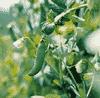 Pea (Pisum sativum)Walter ChandohaII(as used in expressions)black eyed pea
* * *
▪ legumeany of several species, comprising hundreds of varieties, of herbaceous annual plants belonging to the family Leguminosae, grown virtually worldwide for their edible seeds. Pisum sativum is the common garden pea of the Western world. While their origins have not been definitely determined, it is known that these legumes are one of the oldest of cultivated crops; fossil remains have been found in Swiss lake villages. Wild peas grew in medieval Britain. Peas in the United States were introduced in early colonial times. Common garden peas in a monastery garden in Austria in the mid-1800s were used by the monk Gregor Mendel in his pioneering studies of the nature of heredity.The pea plant is a hardy, leafy annual with hollow trailing or climbing stems that reach up to 1.8 m (6 feet) in length and end in tendrils that facilitate climbing. Each leaf has three pairs of leaflets. The reddish purple, pink, or white flowers, growing two to three per stalk, are butterfly-shaped. The fruit is a many-seeded pod that grows to 10 cm (4 inches) long, splitting in half when ripe. Inside the pod, 5 to 10 seeds are attached by short stalks. The seeds are green, yellow, white, or variegated. Widely grown varieties include dwarf, half-dwarf, trailing, smooth-seeded, wrinkled-seeded, and black-eyed. Some varieties, called sugar peas, produce pods that are edible. The pods are picked before the seeds reach maturity and are eaten raw or cooked like green beans; they are popular in East Asian cuisines.In the home garden, peas should be planted in fertile, well-drained soil in an unshaded spot. The cool part of the growing season favours growth and development. The most common diseases that affect peas are root rot, powdery mildew, and several viral diseases. In the United States, peas are grown in the winter and early spring in parts of the Southwest and southern California. Commercial production in the United States centres in the northern tier of states, especially the Great Lakes states and the Pacific Northwest. Washington and Idaho produce dry, edible peas used in soup. Dried peas are sometimes ground into flour. Europe and the North American continent produce the majority of the fresh pea crop for table use. Canning and freezing processes vary according to variety, plant size, shape and size of the pods, and period of maturation.* * *
Universalium. 2010.