

- Palmyra
-
/pal muy"reuh/, n.an ancient city in central Syria, NE of Damascus: reputedly built by Solomon. Biblical name, Tadmor.
* * *
Said to have been built by King Solomon, it became prominent in the 3rd century BC, when the Seleucid dynasty made the road through Palmyra one of the routes of east-west trade. Under Roman control by the reign of Tiberius, it briefly regained autonomy in the 3rd century AD under the Arab queen Zenobia. The main military station on the road that linked Damascus to the Euphrates River, it was conquered by the Muslims in 634. Inscriptions in the Aramaic language supply information on the city's trade with India via the Persian Gulf and with Egypt, Rome, and Syria. Ancient ruins reveal the city's plan.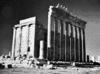 Temple of Bel, Palmyra, Syria.H. Roger-Viollet
* * *
town (township), Wayne county, western New York, U.S., on the New York State Canal System, 20 miles (32 km) east-southeast of Rochester. Founded in 1789 as a frontier town and named for the ancient Syrian city of Palmyra, the locale is associated with Joseph Smith (Smith, Joseph), whose claims of visions there led to his founding the Church of Jesus Christ of Latter-day Saints (the Mormon Church) in 1830 at Fayette, 28 miles (45 km) southeast. Smith's boyhood Palmyra home (restored) is near the Sacred Grove, where his first vision occurred in 1820. At nearby Hill Cumorah, as directed by the angel Moroni, he is said to have unearthed (1827) the Golden Plates from which he translated the Book of Mormon. (Mormon, Book of) A 40-foot (12-metre) monument to the angel crowns the hill, site of an annual Mormon pageant that takes place for seven nights beginning in late July. The village of Palmyra was separately incorporated in 1828. Dairy and vegetable farms are in the area and mechanical packings (sealing materials for pumps and valves) and paper boxes are manufactured. Area 34 square miles (87 square km). Pop. (1990) 7,690; (2000) 7,672.▪ Syriaancient city in south-central Syria, 130 miles (210 km) northeast of Damascus. The name Palmyra, meaning “city of palm trees,” was conferred upon the city by its Roman (ancient Rome) rulers in the 1st century CE; Tadmur, Tadmor, or Tudmur, the pre-Semitic name of the site, is also still in use. The city is mentioned in tablets dating from as early as the 19th century BCE. It attained prominence in the 3rd century BCE, when a road through it became one of the main routes of east-west trade. Palmyra was built on an oasis lying approximately halfway between the Mediterranean Sea (west) and the Euphrates River (Tigris-Euphrates river system) (east), and it helped connect the Roman world with Mesopotamia (Mesopotamia, history of) and the East.Although autonomous for much of its history, Palmyra came under Roman control by the time of the emperor Tiberius (reigned 14–37 CE). After visiting the city (c. 129), the emperor Hadrian declared it a civitas libera (“free city”), and it was later granted by the emperor Caracalla the title of colonia (colony), with exemption from taxes.The city thus prospered, and the 2nd and 3rd centuries CE were the great age of Palmyra and its extensive trading activities, despite obstacles that interrupted caravan trade with the East, and also in the face of instability around the Roman-controlled Mediterranean. When the Sāsānians (Sāsānian dynasty) supplanted the Parthians (Parthia) in Persia and southern Mesopotamia (227), the road to the Persian Gulf was soon closed to Palmyrene trade. These difficulties led the Romans to set up the personal rule of the family of Septimius Odaenathus (Odaenathus, Septimius) at Palmyra. He was appointed governor of Syria Phoenice by the emperor Valerian (reigned 253–260), but it was apparently his son, the emperor Gallienus, who conferred on Odaenathus the title of corrector totius Orientis (“governor of all the East”). Both Odaenathus and his eldest son, the heir apparent, were assassinated, however, reputedly at the command of Odaenathus' second wife, Zenobia, who took control of the city and became an effective leader. Under her rule, the armies of Palmyra conquered most of Anatolia (Asia Minor) in 270, and the city declared its independence from Rome. The Roman emperor Aurelian, however, regained Anatolia in 272 and razed Palmyra the following year.The city remained the chief station on the strata Diocletiana, a paved road that linked Damascus to the Euphrates, but in 634 it was taken by Khālid ibn al-Walīd in the name of the first Muslim caliph, Abū Bakr. After that, its importance as a trading centre gradually declined.The language of Palmyra was Aramaic (Aramaic language); its two systems of writing—a monumental script and a Mesopotamian cursive—reflect the city's position between East and West. The great bilingual inscription known as the Tariff of Palmyra and the inscriptions carved below the statues of the great caravan leaders reveal information on the organization and nature of Palmyra's trade. The Palmyrenes exchanged goods with India via the Persian Gulf route and also with such cities as Coptos (Qifț) on the Nile River, Rome, and Doura-Europus (Dura-Europus) in Syria.The principal deity of the Aramaeans of Palmyra was Bol (probably an equivalent to Baal). Bol soon became known as Bel by assimilation to the Babylonian god Bel-Marduk. Both gods presided over the movements of the stars. The Palmyrenes associated Bel with the sun and moon gods, Yarhibol and Aglibol, respectively. Another heavenly triad formed around the Phoenician god Baal Shamen, the “lord of heaven,” more or less identical with Hadad. A monotheistic tendency emerged in the 2nd century CE with the cult of an unnamed god, “he whose name is blessed forever, the merciful and good.”The ruins at Palmyra clearly reveal the network plan of the ancient city. Along the principal east-west street, named the Grand Colonnade by archaeologists, a double portico is ornamented with three nymphaea (nymph). To the south are the agora, the Senate House, and the theatre. Other ruins include a vast complex called Diocletian's Camp and the chief Palmyrene sanctuary, dedicated to Bel, Yarhibol, and Aglibol; a number of significant ancient Christian churches have also been uncovered. In architecture the Corinthian order marks almost all the monuments, but the influence of Mesopotamia and Iran is also clearly evident. In addition, art found on monuments and tombs reflects the influences of the surrounding Roman and Persian empires. The ruins of the ancient city of Palmyra were designated a UNESCO World Heritage site in 1980.* * *
Universalium. 2010.