

- Doll
-
/dol/, n.
* * *
Small-scale figure of a human being or animal, used especially as a child's plaything.The doll is perhaps humankind's oldest toy. Some ancient dolls may have served religious or magical functionsas do voodoo (see vodun) dolls in modern times. Dolls were buried in children's graves in Egypt, Greece, and Rome and in early Christian catacombs. In Europe dolls have been commercially manufactured since about the 16th century. Doll heads were made of wood, terra-cotta, alabaster, and wax, while the bodies were made of carved wood or leather stuffed with sawdust. In about 1820 glazed porcelain (Dresden) doll heads and unglazed bisque (ceramic) heads became popular. These were supplanted in the 20th century by molded plastic. In Japan, dolls are used as traditional festival figures. In India, elaborately dressed dolls were given to child brides by both Hindus and Muslims. Today both antique and modern dolls are often collected.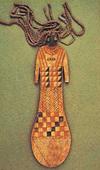 Painted wooden Egyptian doll, 2000 BC.Courtesy of the trustees of the British Museum
* * *
a child's toy modeled in human or animal form. It is perhaps the oldest plaything.No dolls have been found in prehistoric graves, probably because they were made of such perishable materials as wood and fur or cloth, but a fragment of a Babylonian alabaster doll with movable arms has been recovered. Dolls dating from 3000–2000 BC, carved of flat pieces of wood, geometrically painted, with long, flowing hair made of strings of clay or wood beads, have been found in some Egyptian (Egypt, ancient) graves.Some ancient dolls may have had religious meaning, and some authorities often argue that the religious doll preceded the toy. In ancient Greece and Rome, marriageable girls consecrated their discarded dolls to goddesses. Dolls were buried in children's graves in Egypt, Greece, and Rome and in early Christian catacombs. Ancient rag, or stuffed, dolls have been found, as well as dolls crocheted of bright wool and others with woolen heads, clothed in coloured wool frocks.As early as 1413 there were Dochenmacher, or doll makers, in Nürnberg, Germany, which, from the 16th to the 18th century, was the leading manufacturer of dolls and toys. Paris was another early mass-producer of dolls, making chiefly fashion dolls. Doll's houses were also popular in Europe from the 16th century.Doll heads were made of wood, terra-cotta, alabaster, and wax—the last a technique perfected in England by Augusta Montanari and her son Richard (c. 1850–87), who popularized infant dolls. About 1820, glazed porcelain (Dresden) doll heads and unglazed bisque (ceramic) heads became popular. A French bisque doll made by the Jumeau family in the 1860s had a swivel neck; the body was made of kid-covered wood or wire or of kid stuffed with sawdust, a type of manufacture that remained common until it was supplanted by molded plastics in the 20th century (see photograph—>). Socket joints, movable eyes, dolls with voices, and walking dolls were introduced in the 19th century, as were paper-doll books and dolls of India rubber or gutta-percha. The period from 1860 to 1890 was the golden age of the elaborately dressed Parisian bisque fashion dolls and the smaller “milliner's models.”The oldest American dolls may be those found in Inca and Aztec graves (see ), such as those near the pyramids of Teotihuacán. Colonial dolls mostly followed European models. Among American Indian dolls, the kachina doll of the Pueblo Indians is noteworthy.In Japan, dolls are more often festival figures than playthings. At the girls' festival held in March, dolls representing the emperor, empress, and their court are displayed; girls from 7 to 17 visit each other's collections, and refreshments are offered: first, to their majesties, then to the guests, in a ritual more than 900 years old. Japanese boys also have an annual doll festival, from the first May after they are born until they are about 15 years old. Warrior dolls, weapons, banners, and legendary-figure groups are displayed to encourage chivalrous virtues.In India, elaborately dressed dolls were given to child brides by both Hindus and Muslims. In Syria, girls of marriageable age hang dolls in their windows. In South Africa, among the Mfengu people, every grown girl is given a doll to keep for her first child; on its birth, the mother receives a second doll to keep for the second child.In the 20th century, notably popular dolls included the teddy bear (1903); the Kewpie Doll (1903); the Bye-lo Baby, who closed her eyes in sleep (1922); the Dydee and Wetsy Betsy dolls (1937); the Barbie doll (1959; see ); Cabbage Patch Kids (1983); and the American Girls Collection (1986).* * *
Universalium. 2010.