Earliest recorded Germanic languages
- Earliest recorded Germanic languages
-
Earliest recorded Germanic languages
approximate dates, AD
early runic 200–600
Gothic 350
Old High German 750–1050
Old Norwegian 1150–1450
Old Icelandic 1150–1500*
Middle Netherlandic 1170–1500*
Old Danish 1250–1500*
Old Swedish 1250–1500*
Old Frisian 1300–1500*
*Standard cutoff date for beginnings of modern Germanic languages.
See as table: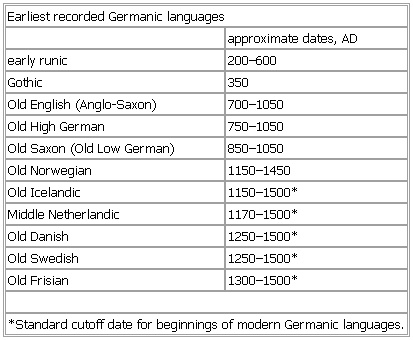
* * *
Universalium.
2010.
Look at other dictionaries:
Germanic languages — Branch of the Indo European language family, comprising languages descended from Proto Germanic. These are divided into West Germanic, including English, German, Frisian, Dutch, Afrikaans, and Yiddish; North Germanic, including Danish, Swedish,… … Universalium
Germanic languages — Infobox Language family name = Germanic altname = Teutonic region = Originally in northern, western and central Europe; today worldwide familycolor = Indo European fam1 = Indo European child1 = East Germanic child2 = North Germanic child3 = West… … Wikipedia
West Germanic languages — Introduction group of Germanic languages that developed in the region of the North Sea, Rhine Weser, and Elbe. Out of the many local West Germanic dialects the following six modern standard languages have arisen: English (English language),… … Universalium
Germanic verb — The Germanic language family is one of the language groups that resulted from the breakup of Proto Indo European (PIE). It in turn divided into North, West and East Germanic groups, and ultimately produced a large group of mediaeval and modern… … Wikipedia
Germanic peoples — The Germanic peoples are a historical group of Indo European speaking peoples, originating in Northern Europe and identified by their use of the Germanic languages which diversified out of Common Germanic in the course of the Pre Roman Iron Age.… … Wikipedia
Indo-European languages — Family of languages with the greatest number of speakers, spoken in most of Europe and areas of European settlement and in much of southwestern and southern Asia. They are descended from a single unrecorded language believed to have been spoken… … Universalium
Indo-European languages — Indo European redirects here. For other uses, see Indo European (disambiguation). See also: List of Indo European languages Indo European Geographic distribution: Before the 16th century, Europe, and South, Central and Southwest Asia; today… … Wikipedia
Romance languages — romance1 (def. 8). [1770 80] * * * Group of related languages derived from Latin, with nearly 920 million native speakers. The major Romance languages French, Spanish, Portuguese, Italian, and Romanian are national languages. French is probably… … Universalium
Uralic languages — Family of more than 30 languages spoken by some 25 million people in central and northern Eurasia. A primary division is between the Finno Ugric languages, which account for most of the languages and speakers, and the Samoyedic languages. The… … Universalium
Romance languages — Romance Geographic distribution: Originally Southern Europe and parts of Africa; now also Latin America, Canada, parts of Lebanon and much of Western Africa Linguistic classification: Indo European Italic … Wikipedia

