
You can mark you interesting snippets of text that will be available through a unique link in your browser.

Russell, Bertrand (Arthur William), 3rd Earl Russell

Russell, Bertrand (Arthur William), 3rd Earl Russell
born May 18, 1872, Trelleck, Monmouthshire, Eng.
died Feb. 2, 1970, near Penrhyndeudraeth, Merioneth, Wales

British logician and philosopher.

He is best known for his work in mathematical logic and for his advocacy on behalf of a variety of social and political causes, especially pacifism and nuclear disarmament. He was born into the British nobility as the grandson of Earl Russell, who was twice prime minister of Britain in the mid-19th century. He studied mathematics and philosophy at Cambridge University, where he came under the influence of the idealist philosopher J.M.E. McTaggart, though he soon rejected idealism in favour of an extreme Platonic realism. In an early paper, "On Denoting" (1905), he solved a notorious puzzle in the philosophy of language by showing how phrases such as "The present king of France," which have no referents, function logically as general statements rather than as proper names. Russell later regarded this discovery, which came to be known as the "theory of descriptions," as one of his most important contributions to philosophy. In The Principles of Mathematics (1903) and the epochal Principia Mathematica (3 vol., 1910–13), which he wrote with Alfred North Whitehead, he sought to demonstrate that the whole of mathematics derives from logic. For his pacifism in World War I he lost his lectureship at Cambridge and was later imprisoned. (He would abandon pacifism in 1939 in the face of Nazi aggression.) Russell's best-developed metaphysical doctrine, logical atomism, strongly influenced the school of logical positivism. His later philosophical works include The Analysis of Mind (1921), The Analysis of Matter (1927), and Human Knowledge: Its Scope and Limits (1948). His A History of Western Philosophy (1945), which he wrote for a popular audience, became a best-seller and was for many years the main source of his income. Among his many works on social and political topics are Roads to Freedom (1918); The Practice and Theory of Bolshevism (1920), a scathing critique of Soviet communism; On Education (1926); and Marriage and Morals (1929). In part because of the controversial views he espoused in the latter work, he was prevented from accepting a teaching position at the City College of New York in 1940. After World War II he became a leader in the worldwide campaign for nuclear disarmament, serving as first president of the international Pugwash Conferences on nuclear weapons and world security and of the Campaign for Nuclear Disarmament. In 1961, at the age of 89, he was imprisoned for a second time for inciting civil disobedience. He received the Nobel Prize for Literature in 1950.
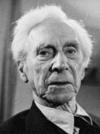
Bertrand Russell, 1960

By courtesy of the British Broadcasting Corporation, London

* * *


Universalium. 2010.

  
Share  

Look at other dictionaries:

  • Russell , Bertrand Arthur William — Russell , Bertrand Arthur William, third earl Russell (1872–1970) British philosopher and mathematician Russell, who was born at Trelleck, England, was orphaned at an early age and brought up in the home of his grandfather, the politician Lord… …   Scientists

  • Russell, Bertrand — ▪ British logician and philosopher in full  Bertrand Arthur William Russell, 3rd Earl Russell of Kingston Russell, Viscount Amberley of Amberley and of Ardsalla  born May 18, 1872, Trelleck, Monmouthshire, Wales died Feb. 2, 1970,… …   Universalium

  • Bertrand Russell — Infobox Philosopher region = Western Philosophy era = 20th century philosophy color = #B0C4DE image caption = Russell in 1907 image size = 150px name = Bertrand Arthur William Russell, 3rd Earl Russell birth = birth date|df=yes|1872|5|18 Trellech …   Wikipedia

  • William — /wil yeuhm/, n. 1. a word formerly used in communications to represent the letter W. 2. a male given name: from Germanic words meaning will and helmet. * * * (as used in expressions) Huddie William Ledbetter Aberhart William George William… …   Universalium

  • Arthur — /ahr theuhr/, n. 1. Chester Alan, 1830 86, 21st president of the U.S. 1881 85. 2. legendary king in ancient Britain: leader of the Knights of the Round Table. 3. a male given name. * * * (as used in expressions) Port Arthur Adamov Arthur Arthur s …   Universalium

  • Russell — /rus euhl/, n. 1. Bertrand (Arthur William), 3rd Earl, 1872 1970, English philosopher, mathematician, and author: Nobel prize for literature 1950. 2. Charles Edward, 1860 1941, U.S. journalist, sociologist, biographer, and political leader. 3.… …   Universalium

  • Bertrand — /berr treuhnd/; Fr. /berdd trddahonn /, n. a male given name, French form of Bertram. * * * (as used in expressions) Aristide Jean Bertrand Beauvoir Simone Lucie Ernestine Marie Bertrand de Bertrand de Got Russell Bertrand Arthur William 3rd Earl …   Universalium

  • count — count1 /kownt/, v.t. 1. to check over (the separate units or groups of a collection) one by one to determine the total number; add up; enumerate: He counted his tickets and found he had ten. 2. to reckon up; calculate; compute. 3. to list or name …   Universalium

  • United States — a republic in the N Western Hemisphere comprising 48 conterminous states, the District of Columbia, and Alaska in North America, and Hawaii in the N Pacific. 267,954,767; conterminous United States, 3,022,387 sq. mi. (7,827,982 sq. km); with… …   Universalium

  • performing arts — arts or skills that require public performance, as acting, singing, or dancing. [1945 50] * * * ▪ 2009 Introduction Music Classical.       The last vestiges of the Cold War seemed to thaw for a moment on Feb. 26, 2008, when the unfamiliar strains …   Universalium