

- Bohemian school
-
School of visual arts that flourished in and around Prague in the later 14th century.Charles IV attracted artists and scholars to Prague from all over Europe. French and Italian manuscripts inspired a local school of book illumination. Though most of the painters are anonymous, their achievements in panel painting and fresco had an important influence on German Gothic art. A vital Bohemian tradition in architecture provided the impetus for the great German Gothic architecture of the 15th century.
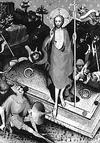 Giraudon/Art Resource, New York
* * *
school of the visual arts that flourished in and around Prague under the patronage of Charles IV, king of Bohemia from 1346 and Holy Roman emperor from 1355 to 1378. Prague, as Charles's principal residence, attracted many foreign artists and local masters. Although it was heavily exposed to the artistic traditions of France and northern Italy (mainly through the importation of illuminated manuscripts), Prague nevertheless produced a vital Bohemian tradition in architecture (Western architecture) and a distinctive, independent style in painting that had an important influence on 14th-century, late- Gothic art, especially that of Germany.The major architectural monuments of the Bohemian school are Charles's palace (Karlštejn Castle) and the St. Vitus' Cathedral, both in Prague. The cathedral and parts of Karlštejn Castle were begun according to routine French design by the Flemish master mason Mathieu d'Arras; when Mathieu died in 1352 the work on both buildings was taken over by the influential German architect Petr Parléř (Parléř, Petr), who, in his virtuoso experiments with decorative vault design in the cathedral, provided the starting point for late German Gothic architectural achievements in the 15th century.The most significant achievements of the Bohemian school were in fresco and panel painting. Most of the painters of the school are anonymous, but a few distinct personalities can be discerned who seem to exemplify three fairly well-defined generations of artists. Before the emergence of the Bohemian school proper, impetus was given by the work of Tommaso da Modena, a northern Italian painter who created a number of panel paintings for Charles. His work was not directly influential on the first generation of Bohemian painters who, working in the 1350s and typified by the Master of the Hohenfurth Altarpiece (or Master of the Vyšší Brod Cycle), were strongly affected by the more elegant models of the Sienese school, though they already exhibited the dark intensity characteristic of Bohemian painting. Tommaso's style, however, was important in the formation of that of Theodoricus of Prague, a member of the second generation of Bohemian artists (working c. 1360–80) and perhaps the principal master of the Bohemian school. Commissioned by Charles to decorate the Chapel of Holy Cross at Karlštejn Castle (c. 1357–67), Theodoricus painted a crucifixion and a host of panel paintings of saints. Although these works show Sienese influence, they are also closely related to Tommaso da Modena's paintings in their naturalism, psychological penetration, and solid modeling. The emphasis on modeling manifests itself in Theodoricus' works in a solemn, massive rendering of heavily rounded faces and thick, heavy drapery, a consolidation of the so-called soft style that was to dominate German painting well into the 15th century.Other artists, working in the Emmaus Monastery at Prague in about 1360, produced frescoes of the life of Christ, with deep, crowded compositions, fluent lustrous draperies, substantial figures, and forceful characterization. The last major artist of the Bohemian school, who represented the third generation of artists (working between about 1380 and 1390), was the Master of Wittingau (or Master of the Třeboň Altarpiece). His major works are the Wittingau altar Passion scenes, originally painted in about 1380 for the town of Třeboň (German: Wittingau). His style is evolved from that of Theodoricus: in their mystical quality and almost abstract emphasis on simple solid forms with smooth surfaces, Theodoricus' paintings anticipate the expressive use of chiaroscuro (light and dark contrast) and the smoldering intensity of the Wittingau Passion. The Master of Wittingau, however, seems also to have been influenced much more strongly than his predecessors by contemporary French painting.Charles's son Wenceslas, who succeeded his father as sole ruler of Germany and Bohemia in 1378, sponsored a flourishing school of manuscript illumination (illuminated manuscript). Prague's role as a prominent artistic centre declined, however, in the early 15th century, largely as a result of severe political and religious conflicts within the empire.* * *
Universalium. 2010.