

- willow
-
—willowlike, adj. —willowish, adj./wil"oh/, n.1. any tree or shrub of the genus Salix, characterized by narrow, lance-shaped leaves and dense catkins bearing small flowers, many species having tough, pliable twigs or branches used for wickerwork, etc. Cf. willow family.2. the wood of any of these trees.3. Informal. something, esp. a cricket bat, made of willow wood.4. Also called willower, willy. a machine consisting essentially of a cylinder armed with spikes revolving within a spiked casing, for opening and cleaning cotton or other fiber.v.t.5. to treat (textile fibers) with a willow.[bef. 900; ME wilwe, var. of wilghe, OE welig; c. OS wilgia, D wilg, LG wilge]
* * *
Any shrub or tree of the genus Salix, family Salicaceae, native mostly to northern temperate regions, and common in lowland and marshy areas.Willows are valued as ornamentals and for their shade, erosion control, and timber. Certain species yield salicin, the source of salicylic acid used in pain relievers. All species have alternate, usually narrow leaves, catkins, and seeds with long, silky hairs. Pussy willows, the male form of several shrubby species, have woolly catkins that form before the leaves appear and are considered one of the first signs of spring. Weeping willows have long drooping branches and leaves. Several species grow as small matted woody plants on the tundra.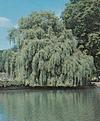 Weeping willow (Salix babylonica).A to Z Botanical Collection-EB Inc.,
* * *
▪ plant genusshrubs and trees of the genus Salix, family Salicaceae, mostly native to north temperate areas, valued for ornament, shade, erosion control, and timber. Salicin, source of salicylic acid used in pain relievers, is derived from certain willows. All species have alternate, usually narrow leaves and catkins, male and female on separate trees; the seeds have long, silky hairs.Three of the largest willows are black (S. nigra), crack, or brittle (S. fragilis), and white (S. alba), all reaching 20 metres (65 feet) or more; the first named is North American, the other two Eurasian but naturalized widely. All are common in lowland situations.Widespread from Mexico to Chile, the Chilean willow (S. chilensis) reaches 18 m; the columnar Xochimilco willow (S. chilensis fastigiata) is a variety especially common at Xochimilco near Mexico City.The shrubby common, or silky, osier (S. viminalis) supplies twigs used for basketmaking in Europe. Woolly willow (S. lanata), of northern Eurasia, to over 1 m, has woolly white leaf buds.Several species and hybrids with drooping habit are called weeping willows, especially S. babylonica and its varieties from East Asia. From northern Asia, S. matsudana has sharply toothed leaves, whitish beneath. One variety, S. matsudana tortuosa, is called corkscrew willow for its twisted branches.Pussy willows (pussy willow), the male form of several shrubby species, have woolly catkins that are considered a harbinger of spring. The catkins are formed before the leaves appear. The North American S. discolor (see photograph—>) is slightly smaller than the Eurasian species, which attain a maximum 7.5 m.There are numerous shrubby willows common along watercourses (e.g., S. purpurea and S. sericea) and several range to the tundra, where they grow as small matted woody plants (e.g., S. arctica and S. glacialis).* * *
Universalium. 2010.